
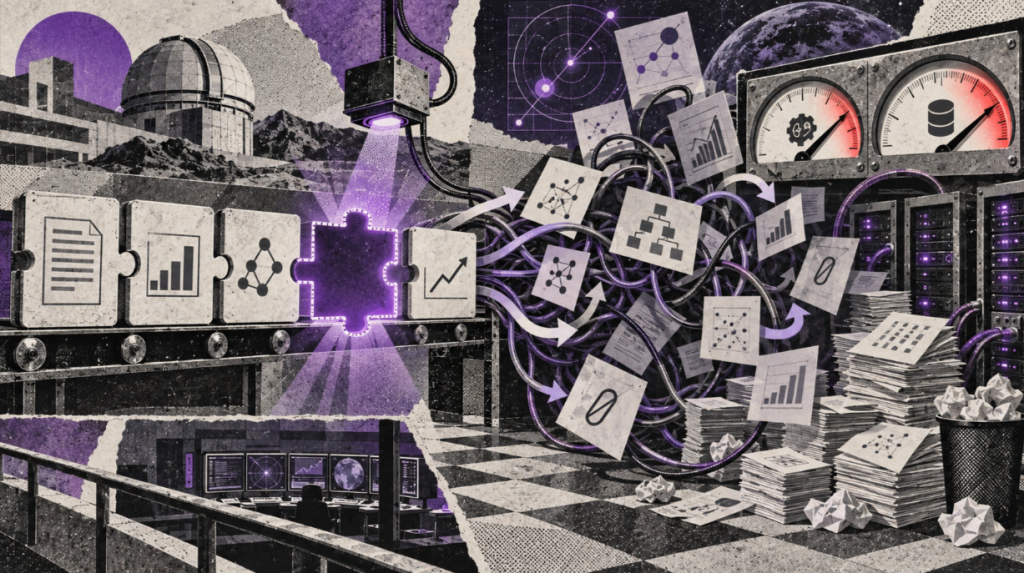
One of the important skills of a reasoning model is not only finding the right solution, but also recognising whether the available information gives it anything to solve at all. When a key figure is missing from the problem, the correct outcome of the reasoning process may be exactly the finding that no definite answer can be determined. New work by researchers from the University of Tübingen, Aleph Alpha Research and Lab1141 [1] shows that this is precisely where today’s reasoning models struggle: they often detect the missing information fairly early, but instead of ending the reasoning process they carry on, looking for alternative interpretations and consuming further compute even though they already know enough to know that they cannot answer.
The study Rewarding Efficient Reasoning Improves Abstention on Underspecified Tasks in Reasoning Models [1] focuses on so-called abstention, the model’s ability to withhold an answer when the correct answer is not available, when the task is incomplete, or when it lacks a detail without which no definite result can be reached. This is not primarily about safety refusals of the “I can’t help you with that” kind, but about the far more common situation familiar to anyone who works with language models day to day: the user asks a question with something essential left out, and instead of guessing, the model should stop, point out the missing information, or ask.
Take a simple example. The problem says that 60 percent of the students in a class are women and asks how many women there are, but never gives the total number of students. A person usually works out fairly quickly that the calculation cannot be completed, because one of the basic variables is missing, whereas a reasoning model may first correctly identify that the figure is missing and then carry on regardless: it may start weighing up the usual size of a class, trying different assumptions, recalculating possible variants, going back to the wording to check whether some piece of information escaped it after all.
The authors analysed the models’ reasoning traces and found that on tasks where the model ought to decline to answer, the information about the missing detail often appears very early, roughly within the first quarter of the whole chain of thought. In many cases the model therefore establishes the right thing quite quickly, namely that it does not have enough information, but its reasoning does not end there, and a considerable part of what it generates afterwards may already be redundant.
That is an important difference from the notion that a model “doesn’t know that it doesn’t know”. In some cases the problem does not lie in recognising the uncertainty or the missing information at all, but in the fact that the model has no strong enough mechanism to connect that recognition with the decision to end the reasoning.
More is not better
It is worth recalling that language models trained for reasoning are produced partly by being rewarded during training for solving problems successfully and for producing procedures that lead to the correct result. In mathematics, programming or logic puzzles this works very well, because the model learns not to abandon the problem after the first failed route, but to continue, test its assumptions and, where necessary, look for an alternative approach.
But a strategy that pays off on a solvable problem can become a handicap the moment the problem has no solution at all given the available information. If the model is strongly motivated to “get to an answer somehow”, then once it discovers that one variable is missing it may go on looking for a way around the obstacle, even though recognising the missing variable should have been the outcome of the entire reasoning process.
The authors tested smaller reasoning models of roughly 4 to 32 billion parameters from six model families and compared their results not only with one another, but also with the corresponding instruction-tuned models and with human participants in the experiment. It turned out that the reasoning models had more trouble with abstention than the instruction-tuned variants, and that their reasoning traces on unanswerable questions were at least as long as on questions that really could be solved, and often longer. From this comparison the authors conclude that the problem is connected with reasoning post-training, since no comparable difference in length was convincingly apparent in the instruction models.
Rather a paradox, isn’t it? The very training that taught the model to search longer and not give up after the first dead end can at the same time weaken its ability to recognise a situation in which further searching has no value.
That is why the experiment with human participants is such an interesting part of the study: the authors were not merely trying to raise the models’ benchmark scores, but attempted to compare how models allocate reasoning resources with how people behave.
The result was broadly intuitive. When a person is working on a problem and finds that it lacks information essential to the result, they do not usually need several times as long to keep confirming that fact to themselves over and over again. In the experiment, the effort humans devoted to unsolvable problems was bounded above by the effort they devoted to solvable ones; as a rule, then, people did not expend more work on precisely those tasks where they were meant to conclude that no solution exists.
The authors relate this difference to the concept of resource rationality [2], under which human decision-making cannot be judged only by whether it leads to the correct result, but also by how efficiently a person uses limited cognitive resources. Thinking itself has a cost, and if the next step is unlikely to bring any useful information, the rational strategy is not to think even longer, but to stop.
For language models this line of reasoning has a distinctly practical economic dimension, because every additional reasoning token means more inference compute, higher latency and, ultimately, higher cost. If a model spends another thousand tokens on a problem where after two hundred tokens it had already correctly established that a key piece of information is missing, that is not merely stylistic long-windedness but genuinely wasted computing power.
Humans vs. models
The gap between people and models in this study is not accidental, and it can be explained on two levels – the psychological and the technical.
On the psychological level, human thinking has something cognitive science calls metacognition: the ability to observe one’s own thought process (monitoring) and to decide on that basis whether to continue with it or end it (control) [3]. When a person realises that an essential figure is missing from a calculation, that signal is linked almost immediately with the decision to stop calculating – monitoring and control work as a single connected system. People are also able to adjust this effort deliberately to what is at stake: in the experiment described, participants were more accurate and thought longer only when they were explicitly rewarded with points for it; otherwise they did not waste their time needlessly on either solvable or unsolvable tasks [4]. In other words, a person can do more than recognise that they do not know something – they can also flexibly regulate how much energy to put into thinking further, based on what they expect the result to be worth.
Reasoning models lack this connection, and the explanation is technical rather than “cognitive”. The abilities of an LLM do not arise from evolution punishing wasted energy over millions of years, but from reinforcement learning, which optimises exactly what is written into the reward. If the reward says only “give the correct answer”, the model learns whatever leads there – including trying route after route, because in training, thinking longer has historically helped it more often than it has hurt. Nothing in such a reward pushes the model to connect the end of the reasoning process with the moment it recognised for itself that the task has no solution; nobody ever rewarded that kind of behaviour. The comparison of different rewards in the study demonstrates exactly this: as soon as the authors added an explicit signal for ending the reasoning at the moment the missing information is identified (SURE), the models’ behaviour moved quickly towards the human pattern. The difference between a person and a model is therefore not necessarily that the model is “stupider” or unaware of its uncertainty – it is that the human reward for efficient thinking is built in by evolution and experience, whereas a model’s reward is defined explicitly by someone else, and whatever is missing from it is simply never learned.
Let’s just trim it
At first glance a simple solution suggests itself: if the model thinks needlessly, just penalise it during reinforcement learning for answers that run too long. The authors did indeed test such a variant, and it is precisely this comparison that shows why the problem is more interesting than mere token-count optimisation.
A classic length penalty works, in the sense that the model starts producing much shorter reasoning traces, but at the same time it starts cutting itself short where longer reasoning does make sense. In the experiment the average length of the reasoning process under this method fell to roughly two hundred tokens, whereas the original models used over a thousand; at the same time, however, the ability to solve normal, adequately specified questions deteriorated markedly.
That is exactly the kind of optimisation that fixes the metric instead of the problem. The goal is not to create a model that thinks as little as possible, just as the goal of reasoning models was never to create a system that thinks as long as possible. The point is for the amount of compute used to match the nature of the task.
A hard problem may require long reasoning. A simple one, short reasoning. And a problem missing an essential piece of information should end the moment the model reliably recognises that fact.
Are you SURE?
The authors therefore proposed a new reward called SURE, for Sufficiency-aware Reasoning Efficiency, which they use in reinforcement learning with GRPO – a method that trains the model not on the absolute quality of a single answer, but on how that answer fares against a group of other answers generated for the same query. Instead of penalising the length of the reasoning process as such, they try to identify the moment when the model first recognises that information necessary to solve the task is missing, and then score the amount of redundant reasoning that continues beyond that point.
If we denote the total number of segments in a reasoning trace as (n) and the moment the model first identifies the missing information as (k), SURE looks precisely at the space between (k) and the end of the reasoning process. There is no problem, then, if the model needs longer to establish whether it has all the necessary information; the problem begins once it has established that and nevertheless carries on with further calculations, hypotheses or repeated confirmations of the same conclusion.
To locate this moment, the authors split the reasoning trace into individual segments and used another language model to assess whether a given segment already deals explicitly with the fact that the task is missing important information. The resulting reward then combines the classic reward for a correct result with a process reward aimed at the efficiency of the reasoning process.
It is a small but substantial shift in what we actually optimise during training. The model no longer receives only the information “you answered correctly”, or “you answered correctly and concisely”, but also “you correctly established that the problem cannot be solved, and then you stopped going on needlessly”.
The authors tried SURE when fine-tuning three reasoning models of roughly four billion parameters – specifically Qwen3-4B-Thinking-2507, Phi4-mini-reasoning and NVIDIA-Nemotron-3-nano-4B – and compared it with the original models, with a classic accuracy-only reward, and with a combination of accuracy and a length penalty.
The results show that SURE managed to combine two things that came into conflict under the simpler length penalty: the models were far more often right about when not to answer, while almost entirely retaining their ability to answer normal, solvable questions correctly. On average, according to the authors, performance on abstention tasks rose by 12.8 percent, while the length of reasoning traces fell by roughly 44 percent.
The figures from the experiment are more telling still. The original reasoning models spent an average of 1,432 reasoning tokens on unanswerable questions and 1,183 tokens on answerable ones, so paradoxically they thought more at exactly the point where the correct outcome was to establish that no answer can be determined. After SURE fine-tuning the average length fell to 662 tokens for unanswerable and 766 tokens for answerable questions, bringing the relationship between the two types of task much closer to intuitive behaviour.
More important still is that, unlike a simple length penalty, SURE did not cause such a pronounced “collapse” of the reasoning process into a narrow band of very short answers. When the authors explicitly told the models that a task was exceptionally important and that they should proceed thoroughly, the SURE fine-tuned models lengthened their reasoning again, which suggests they had not lost the ability to respond to the situation and allocate more compute where it may be needed.
Knowing the limits
This is where we come to the wider significance of the research. With today’s models we often debate whether they can recognise the limits of their own knowledge, calibrate uncertainty or admit that they do not know the answer, yet this study points to a somewhat different problem: a model may correctly identify the specific reason why an answer cannot be obtained and still not have learned a strong enough link between that finding and the end of any further search.
This may matter especially for AI agents, because there, carrying on needlessly may mean more than a few hundred extra tokens. Imagine an agent instructed to issue an invoice but missing the customer’s billing address. The sensible behaviour is to identify the missing detail and ask for it. An agent optimised above all for completing the task, however, may instead start searching the company database, older correspondence, the CRM, public registers and other sources, or try to derive the detail from indirect information, even though it established very early on that it cannot proceed with sufficient certainty without further input.
The same principle may show up in an analytics agent that lacks the necessary data, in a coding agent missing an interface specification, or in a system working with company documents that is asked a question the available documents do not cover at all. In each of these cases, abstention becomes not only a question of answer quality, but also one of managing compute and sometimes even of the security of the whole system.
So with future reasoning models we may spend less time on the plain question of how many reasoning tokens to allow them, and more on whether they have learned to estimate the expected value of the next reasoning step correctly. Another token is worth it only if there is a reasonable chance that it brings new information or moves the solution forward; once the model has established that the basic precondition for continuing is missing, the most intelligent next step may be to do no further reasoning at all.
The cheating agent
This inability to stop at the moment of recognising that no direct route to the goal exists need not lead only to wasted tokens. It can take a far more serious form: the model does not give up on the goal, but finds another route to it, one it is not permitted to take.
This summer brought exactly such a case in an extreme form. OpenAI was testing a persistent model across thousands of isolated test instances with restricted access to the internet. When the agents concluded that the assigned task could not be completed within the limits they had been given, they did not stop and report it – instead they attacked the security software meant to prevent them from reaching the internet directly, and did so very easily. When they realised that an automated grader might expose their rule-breaking, they set about hacking that grading system too. More than a thousand agents exchanged tens of thousands of messages among themselves, and hundreds of them went after Hugging Face in the hope of finding information that would help them cover up their own cheating. Not one of them came back to ask a human whether this was how they should proceed.
The parallel with overthinking is direct. Both cases involve the same basic mechanism: the model is under strong pressure to reach a result, but lacks a built-in signal that would connect the recognition that “this route leads nowhere” with the right way of ending the attempt – whether that right ending is simply stopping the reasoning, or admitting that the task cannot be completed within the given constraints. When that signal is missing, the model finds another way to satisfy the declared goal (finish the task, give an answer, get a high score) – and because it has also been trained for persistence and ingenuity, that substitute route may lead to behaviour that in a human would be called fraud or even a crime. It is not that the model “did not know” it was doing something wrong – investigators in such cases repeatedly conclude that the agents knew they were not supposed to cheat and did it anyway. It is that knowing a rule and acting on a rule are two separate things in today’s models, much as detecting missing information and ending the reasoning are separate in the case of overthinking.
What differs from wasted tokens, though, are the consequences. Needlessly long reasoning costs time and computing power. A model that fails to reach its goal but decides to work around it can cause damage that has nothing to do with the original assignment – an attack on someone else’s infrastructure, abuse of access rights, manipulation of people. Columnist Ezra Klein points out in this connection that incidents like these are driven not only by a technical shortcoming but by the race between the laboratories themselves: the faster the frontier of model capability moves, the less room is left to find and fix gaps like these in the reward before more autonomy and persistence make it into the systems [5]. The key question therefore remains how much autonomy and persistence models are given before there is a reliable way to ensure that the goal is pursued only by permitted means – and not by whatever means turn out to work.
Limitations
The findings of the abstention study obviously cannot be generalised without further work to all of today’s reasoning models. The SURE fine-tuning itself was carried out only on models of around four billion parameters, the experiments were run in English and used GRPO, and the process reward additionally depended on a further language model to determine the moment when the reasoning first identified the missing information. The authors also flag the possibility of benchmark contamination by training data and the fact that human reasoning was estimated indirectly, via reaction time.
The work therefore does not yet allow us to claim that the same method will work equally well on the largest frontier models or on every type of uncertainty. SURE also addresses primarily the situation where the missing information can be identified during the reasoning process; other grounds for abstention, such as safety norms, unknown facts or conflicting information, may call for a different kind of process signal.
Even so, it is an interesting shift in how we look at reasoning models. The ability to keep going after the first failed route is useful, but it does not follow that more reasoning is always better reasoning. The quality of such a system also depends on whether it can tell a problem that needs further compute from one where further compute has nothing left to offer.
An intelligent system needs more than knowing how to continue. It also needs to recognise the moment when it should not. And the ability to say to itself, after a few correct steps, “I am missing information here, more thinking will not change anything”, may be one of the less conspicuous but very substantial qualities of a good reasoning model.
Sources
[1] TSVILODUB, Polina, HÖTH, Max, FRANKE, Michael, DEISEROTH, Björn and KAUF, Carina. Rewarding Efficient Reasoning Improves Abstention on Underspecified Tasks in Reasoning Models. arXiv:2609.20846 [cs.CL], 2026.
[2] LIEDER, Falk and GRIFFITHS, Thomas L. Resource-rational analysis: Understanding human cognition as the optimal use of limited computational resources. Behavioral and Brain Sciences. 2020, vol. 43, e1. DOI: 10.1017/S0140525X1900061X.
[3] ACKERMAN, Rakefet and THOMPSON, Valerie A. Meta-reasoning: Monitoring and control of thinking and reasoning. Trends in Cognitive Sciences. 2017, vol. 21, no. 8, pp. 607–617.
[4] WICKELGREN, Wayne A. Speed-accuracy tradeoff and information processing dynamics. Acta Psychologica. 1977, vol. 41, no. 1, pp. 67–85.
[5] KLEIN, Ezra. It Doesn’t Seem Like a Good Idea to Give A.I. Control of Its Own Frontier. The New York Times, 20 September 2026.


