
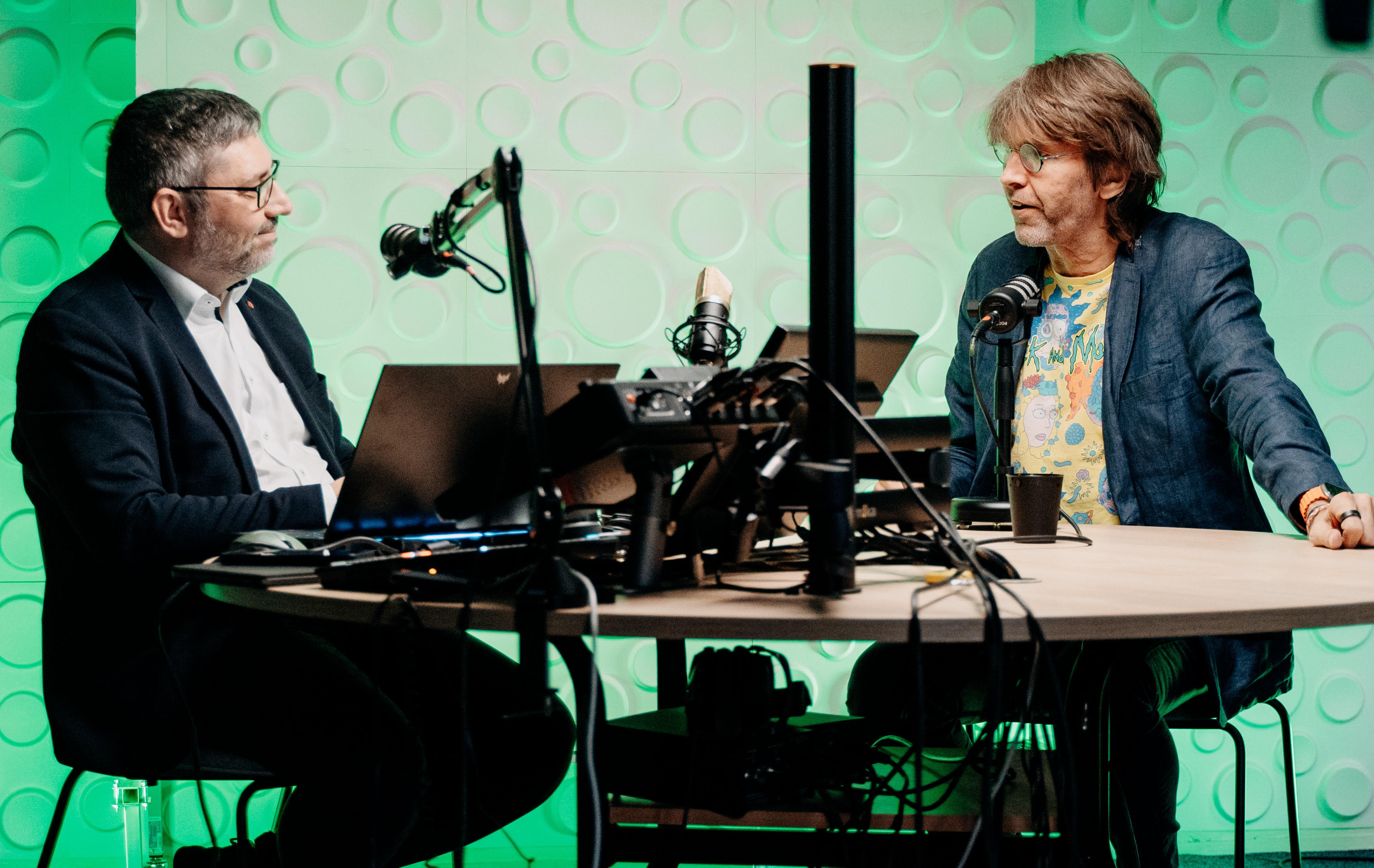
Picture a bloke who wanted to be an astronaut. Except that by the age of ten he was very nearly six foot, and his dreams of space quite literally would not fit through the door. So he stayed on Earth, studied cybernetics and stress, and eventually became a journalist. And today? He cracks jokes, writes, and teaches people how to ask artificial intelligence questions it will genuinely understand.
Miloš Čermák. Six foot nine (or ten, depending on his mood), dozens of books, hundreds of interviews, and now one of the most interesting Czech voices talking about AI without hysteria and without gloss.
He came to Ostrava for an AI marathon: not only a four-hour conversation with Robert Vlach, but also his own course, which he calls AI Masterclass. And somewhere in between he fitted in this interview, which – as tends to happen with good things – had to wait a year for its moment. Why? Partly because it nearly did not come off: of the two microphones recording it in the studio, only one worked the whole time, so half of it had to be reconstructed rather laboriously, with AI lending a hand. The other reason was that the original plan, to release it under the banner of a newly emerging Ostrava AI hub, came to nothing in the end.
But let us leave the circumstances aside and turn to what is actually in it.
Why? Because Miloš Čermák talks about AI differently from most people circling this technology. No “it will change the world” and no “it will kill creativity”. He looks for balance instead. Fascination and respect at once. He says generative AI is a “strange technology”. It behaves like a person, yet it is not one. And that, he argues, is exactly why non-technical people often use it better – people who simply enjoy it.
“IT people are used to speaking to a machine in commands,” he explains. “But this technology needs conversation.”
Although he earns his living by writing, he would never let AI write for him. “I love writing,” he says. “And as long as I enjoy it, I do not want to give it away.” Artificial intelligence saves him time elsewhere, though – in reading, summarising and sorting information. He estimates it saves him fifteen hours a week. “That lets me read ten times more than before.”
He also notices how slowly AI is making its way into companies. “I thought that by this year nobody would be building presentations by hand. And yet nothing happened.” He puts it down to fear – of mistakes, of responsibility, of a new tool nobody has properly explained.
There is more in the conversation than practical tips. There are reflections on what will remain human. Čermák argues that real value will shift from the result to its provenance – to the proof that a human made it. “Blind tastings of wine and blind tests of music show we often cannot tell the difference. But the sommelier sells the bottle for two hundred dollars, because we know they put their time and energy into it.”
AI can write a sonnet in five minutes. But we will still want to know that a creature of flesh and blood wrote it, because that carries an emotion which cannot be copied.
Miloš talks about hallucinations as a creative instrument, about AI being able to handle problems from a mathematical olympiad while never knowing what it is like to fall off a bike or to fall in love. And about how tomorrow’s winners will not be the people who know everything, but the people who know how to ask well.
“What we are learning today is not answers,” he says. “A machine can handle those. But good questions… those will only become more valuable.”
Perhaps that is why this conversation waited a year. Because sometimes a moment has to arrive when you realise the world is changing radically – we just do not yet know exactly how.
Listen to the podcast KUBÍČEK × ČERMÁK on AI. It is recorded in Czech.
On artificial intelligence, humanity and the power of the right questions.
You can listen to the podcast free on Patreon or on YouTube.


